
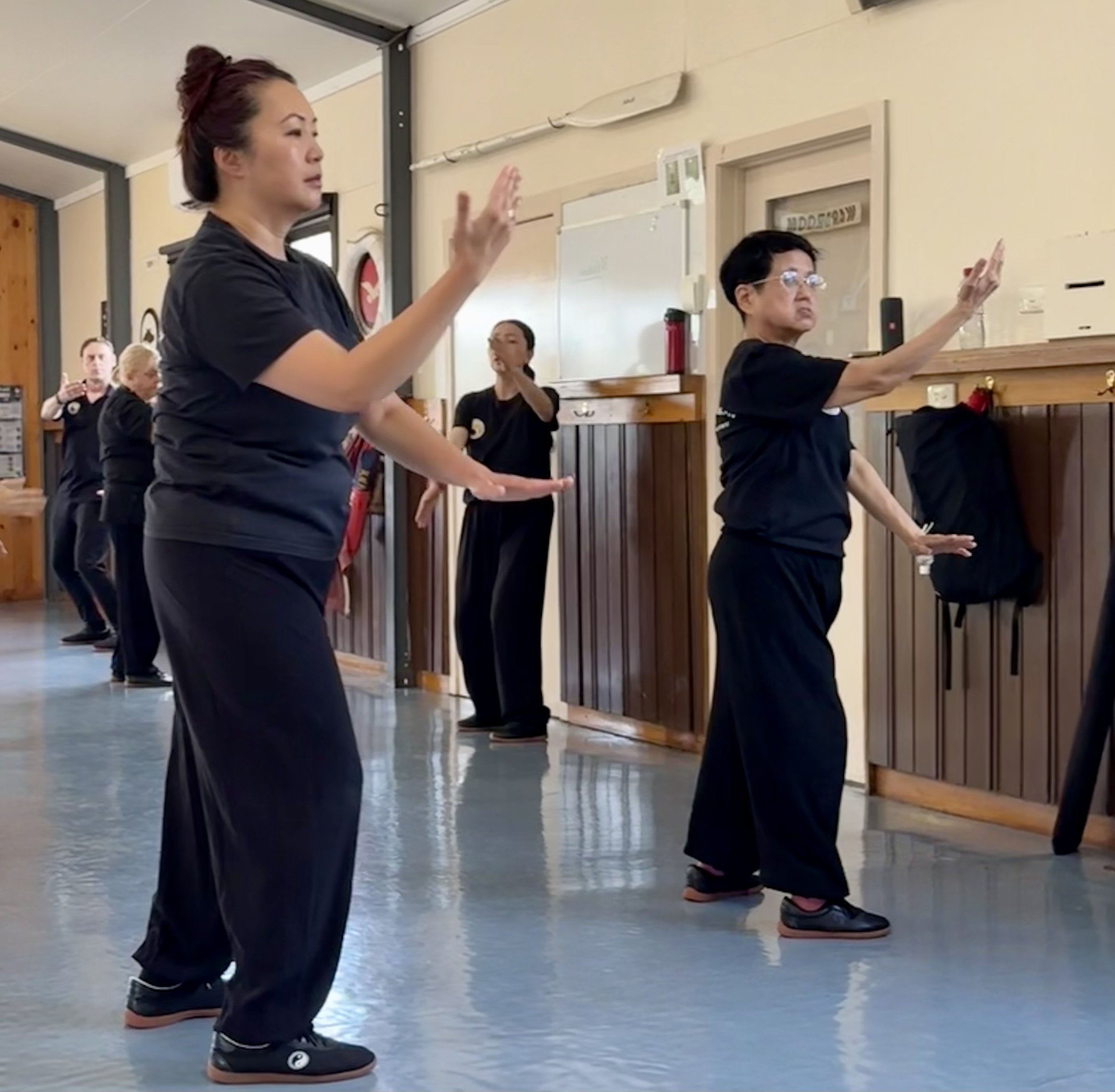
Balance challenges are common after a stroke, affecting up to 50–80% of survivors and often limiting confidence, mobility and independence. A new 2026 clinical study published in Frontiers in Neurology offers compelling evidence that Cloud Hands—a foundation, flowing Tai Chi movement—can meaningfully support balance recovery and functional improvement.
What Is Tai Chi Cloud Hands?
Cloud Hands (Yún Shǒu) is one of the most recognisable foundation Tai Chi movements. Relatively simple to learn it is ideal for beginners, seniors, rehabilitation settings and advanced practitioners alike.
Cloud Hands involves:
Smooth, circular arm movements that flow continuously from side to side
Rhythmic weight shifting from one leg to the other
Gentle trunk rotation that mobilises the spine
Coordinated hand-eye tracking to enhance focus and spatial awareness
Slow, deep abdominal breathing to calm the nervous system
A relaxed but stable stance, with knees softly bent
The movement trains whole‑body integration: the legs root, the waist turns, the arms follow, and the breath anchors the mind. This combination makes Cloud Hands a powerful tool for improving balance, coordination, and mental clarity.
About the Research
The study, investigated whether a short, intensive Cloud Hands program could enhance balance and brain connectivity in people recovering from stroke.
This study included 52 inpatients with post-stroke balance problems. Participants were randomly assigned to receive either standard rehabilitation alone or standard rehabilitation plus Tai Chi Cloud Hands. Both groups completed 30 min of rehabilitation per day, 5 days per week, for 2 weeks. Additionally, the experimental group completed 30 min of Cloud Hands training daily for 2 weeks. Rest intervals were incorporated as needed.
Outcome measures were collected before and after the intervention by assessors blinded to group allocation. The primary outcome was the Berg Balance Scale (BBS), and secondary outcomes included the Modified Barthel Index (MBI). Static balance was assessed using the PROKIN system, which measured centre-ofpressure (COP) path length and sway area. Resting-state brain connectivity was assessed using functional near-infrared spectroscopy (fNIRS) to monitor oxygenated haemoglobin.
Importantly, the authors noted:
“Adding a 2‑week, high‑frequency Tai Chi Cloud Hands programme… was associated with greater improvements in balance, daily function, and static postural stability.”
Key Findings
After just two weeks in the cloud hands intervention group:
Balance improved significantly
Daily function improved
Static postural stability improved
These are meaningful changes for individuals working to regain confidence and independence.
Brain Connectivity Findings
Using fNIRS, researchers observed that Tai Chi Cloud Hands was associated with improved coordination between brain regions responsible for planning, attention, and movement—key elements of balance control.
What ITMeans
1. Cloud Hands strengthens balance through whole‑body integration - The coordinated rotation, shifting and arm spirals train the body to stabilise itself naturally.
2. Improvements occur even over a short program - A 2‑week program produced measurable gains—important for rehabilitation and for students seeking early progress.
3. Cloud Hands practice supports functional independence - Better balance translated into greater ease with daily activities, as reflected in MBI improvements.
4. Cloud Hands may enhance brain network efficiency - The study found strengthened prefrontal–motor connectivity, suggesting Tai Chi may help the brain coordinate movement more effectively.
5. Tai Chi and Cloud Hands is safe, accessible and equipment‑free - No adverse events were reported. Movements can be adapted for different abilities, making it suitable for rehabilitation and community practice.
Conclusion
This research reinforces that Tai Chi movements are a powerful tool for improving balance, stability, and functional wellbeing. Cloud Hands, in particular, is a movement that:
Builds strength without strain
Improves postural control
Enhances coordination and focus
Calms the mind while training the body
At Wulong, our teaching emphasises the same principles used in the study—rooting, coordinated movement, mindful breathing, and whole‑body integration—making these benefits accessible to all students, regardless of age or experience.
Read the research “Effects of Tai Chi Cloud Hands on balance and resting‑state functional connectivity after stroke: an fNIRS study” published 7 May 2026 here https://doi.org/10.3389/fneur.2026.1791157
If you are looking for a program to support your health, try a Wulong class today. Click here to see all our class locations and timings. https://www.wulongtaichi.com.au/tai-chi-classes